
NairobiTravel Guide
Kenya's high-altitude capital is the only major city on earth with a national park on its doorstep — a green, fast-moving metropolis where safari country begins at the city limits.
Is Nairobi right for you?
Dry season, June to October
Around 28°C by day in March, 24°C in July — recorded at the local weather station.
It depends where you stand. There is a cheap version and an expensive one — the guides below say which is which.
No hour-by-hour route here yet — the guides below cover it by subject instead.
Dry season, June to October
Average daily highs, recorded at Nairobi (Jomo Kenyatta International Airport), 1615 m, 1991-2020 normals.
Where this comes from
Deutscher Wetterdienst; Starlings Roost Weather (via Wikipedia 'Nairobi')
Mixed
Typical cost profile for visitors
- Zanzibar, Tanzania600 km
a full travel day · both good in June, July, August
- Kigali, Rwanda760 km
a full travel day · both good in June, July, August · a different price level (mid)
 Zanzibar
 Kigali
Finding Nairobi
Reading Nairobi

Nairobi for First-Timers: The Complete Guide
Lions with a skyline backdrop, orphaned elephants at breakfast, and Kenya's best nyama choma — how to make sense of East Africa's most compelling capital.

The Most Photogenic Corners of Nairobi, Ranked
Nairobi's best pictures come from collisions - wildlife against a skyline, colonial verandas against traffic, indigenous forest a short drive from a mall - and these are the corners that repay the effort, ranked, costed and ordered so the traffic does not eat your week.

A Rainy Day in Nairobi: The All-Indoor Route
When the rains arrive, Nairobi’s parks turn to mud and its traffic doubles. A full day of museums, galleries, workshops and markets that never needs a clear sky.

Where to Base Yourself in Nairobi: A First-Timer’s Guide
In a city defined by traffic, the neighbourhood you sleep in shapes every day of the trip. A first-timer’s briefing on Nairobi’s five bases and the stays that define them.
Nairobi, framed


What we'd do in Nairobi
See and do
- The Wildlife You Came For
Nairobi National Park begins at the southern edge of the city — lions, rhinos, giraffes, and buffalo grazing with office towers on the horizon.
Read: Nairobi for First-Timers: The Complete Guide - Nairobi National Park
Kenya Wildlife Service bills it as the only national park bordering a capital city, and whatever the precise truth of that, the picture is genuinely unusual: black rhino, giraffe, buffalo, eland and, with patience, lion, grazing with an office skyline on the horizon.
Read: The Most Photogenic Corners of Nairobi, Ranked - History and Culture
The Karen Blixen Museum occupies the farmhouse of the 'Out of Africa' author at the foot of the Ngong Hills.
Read: Nairobi for First-Timers: The Complete Guide - The Giraffe Centre
Rothschild's giraffes lean over a raised wooden platform in Langata, close enough to fill a frame with an eyelash.
Read: The Most Photogenic Corners of Nairobi, Ranked - Airport
Jomo Kenyatta International, typically 30 to 60 minutes from the centre depending on traffic
Read: Nairobi for First-Timers: The Complete Guide
Eat and drink
- Kenyatta Market and the charcoal test
Nyama choma, meat roasted slowly over charcoal, is less a dish than the city's social form, and Kenyatta Market, south of the centre off Ngong Road, is where to meet it properly.
Read: Charcoal, Coconut and Cardamom: A Nairobi Eating Map - Parklands and the kitchens at Diamond Plaza
Kenya's Indian community is more than a century old, and Parklands is its kitchen.
Read: Charcoal, Coconut and Cardamom: A Nairobi Eating Map
Where to stay
- Westlands
The most practical all-round base.
Read: Where to Base Yourself in Nairobi: A First-Timer’s GuideCheck ratesad · Booking.com - Kilimani and Upper Hill
Immediately south and west of the centre, quieter than Westlands and often better value, with a growing restaurant scene and easy reach of the Nairobi National Museum and the city centre.
Read: Where to Base Yourself in Nairobi: A First-Timer’s GuideCheck ratesad · Booking.com - Karen and Langata
Green, low-rise and leafy, out towards the Ngong Hills.
Read: Where to Base Yourself in Nairobi: A First-Timer’s GuideCheck ratesad · Booking.com - Gigiri
The diplomatic quarter, home to the United Nations complex, very green and very calm, with the Village Market complex for shopping and crafts.
Read: Where to Base Yourself in Nairobi: A First-Timer’s GuideCheck ratesad · Booking.com
Practical essentials for Kenya
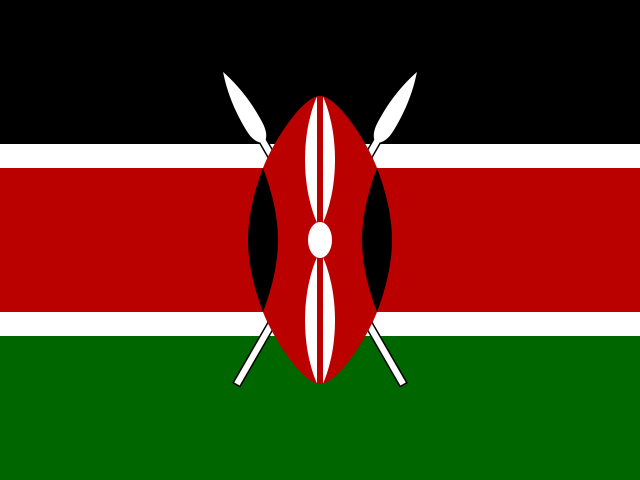 Practical essentials for Kenya
Kenyan shilling (KES)
Swahili and English are both official languages, and English is used throughout business, government and tourism.
Type G, 240V 50Hz
Nairobi runs on privately owned matatu minibuses that carry most commuters and take cash or M-Pesa, but visitors almost always use taxis or the Uber and Bolt apps.
Around 10% is usual in restaurants unless a service charge has already been added, and safari guides are tipped separately at a daily rate.
Treat tap water as unsafe for visitors and drink bottled, boiled or filtered water; hotels and camps supply purified water.
Left-hand side; a valid foreign licence in English is accepted for up to 90 days, otherwise an International Driving Permit or official translation is required.
999 or 112
Country-level guidance, checked against official sources. Currency, fares and entry rules change — confirm anything time-critical before you travel.


 Seychelles
 Zambia
 South Africa
 Egypt
Egypt
 Mauritius


 Ghana
Ghana
 Tunisia
 Morocco