
VallettaTravel Guide
Europe's smallest capital is a UNESCO-listed baroque fortress city built by the Knights of St. John, packed with golden limestone palaces, a Caravaggio masterpiece and harbor views at every street's end.
Is Valletta right for you?
April–June & September–November
Around 32°C by day in August, 16°C in January — recorded at the local weather station.
Mid-range. Comfortable without planning around money, expensive if you stop counting.
No hour-by-hour route here yet — the guides below cover it by subject instead.
April–June & September–November
Average daily highs, recorded at Luqa Airport, Malta (Valletta suburbs), 1991-2020 normals.
Where this comes from
Meteo Climate / MaltaWeather.com (en.wikipedia Valletta weather box) — The Valletta article's box is the Luqa Airport station, which serves the whole of Malta.
Mid-range
Typical cost profile for visitors
- Catania, Italy190 km
a short hop — comfortable overland · both good in April, May, June · a different price level (budget)
- Palermo, Italy270 km
a short hop — comfortable overland · both good in April, May, June · a different price level (budget)
- Tunis, Tunisia400 km
half a day's travel · both good in April, May, June · a different price level (budget)
- Naples, Italy550 km
half a day's travel · both good in April, May, June · a different price level (budget)
 Catania
 Tunis
TunisFinding Valletta
Reading Valletta

When to Visit Valletta: An Honest Season-by-Season Guide
Valletta rewards good timing more than most capitals. A frank look at what each season actually delivers in Malta, from the green weeks of spring to the empty, cut-price museums of winter.

Valletta, Ranked: 8 Experiences You Shouldn't Miss
A Caravaggio in a golden cathedral, cannon fire over the Grand Harbour and Europe's most walkable capital — the eight essential Valletta experiences, ranked.

Market Days in Valletta: What to Eat and When to Show Up
A covered food hall, a weekday street market, and a fishing village Sunday that draws the whole island. Where to eat your way through Malta’s markets, dish by dish and month by month.

Valletta Off-Season: The Quiet Months Locals Keep to Themselves
Skip the August crush. Between November and March, Malta’s capital hands you Caravaggio without a queue, half-price rooms and a Carnival almost nobody flies in for.
Valletta, framed


What we'd do in Valletta
See and do
- Relive the sieges at Fort St Elmo
The star fort at the peninsula's tip bore the brunt of the 1565 Great Siege and again of World War II.
Read: Valletta, Ranked: 8 Experiences You Shouldn't Miss - The case for the cold months
Mild, not cold.
Read: Valletta Off-Season: The Quiet Months Locals Keep to Themselves - Catch anything at the Manoel Theatre
Opened in 1732 and still staging performances, the Manoel is among Europe's oldest working theatres — a tiny gilded jewel.
Read: Valletta, Ranked: 8 Experiences You Shouldn't Miss - The quiet corners
Winter is the season to go beyond the main street.
Read: Valletta Off-Season: The Quiet Months Locals Keep to Themselves - Currency
euro; English is an official language of Malta
Read: Valletta, Ranked: 8 Experiences You Shouldn't Miss
Eat and drink
- Know before you go
Mornings only.
Read: Market Days in Valletta: What to Eat and When to Show Up - The covered market
Valletta's restored nineteenth-century market hall on Merchants Street reopened as a food hall and grocer, and it is the most reliable eating in the city centre: a produce and butcher level below, and a spread of stalls above serving everything from fresh pasta to Maltese platters.
Read: Market Days in Valletta: What to Eat and When to Show Up - The street market
On weekday mornings, stalls fill the length of Merchants Street with clothing, household goods and a scattering of food sellers.
Read: Market Days in Valletta: What to Eat and When to Show Up - Pace yourself
The good version of this day is a small breakfast, pastizzi mid-morning from a hole in the wall, a long market lunch, and something sweet late.
Read: Market Days in Valletta: What to Eat and When to Show Up
Practical essentials for Malta
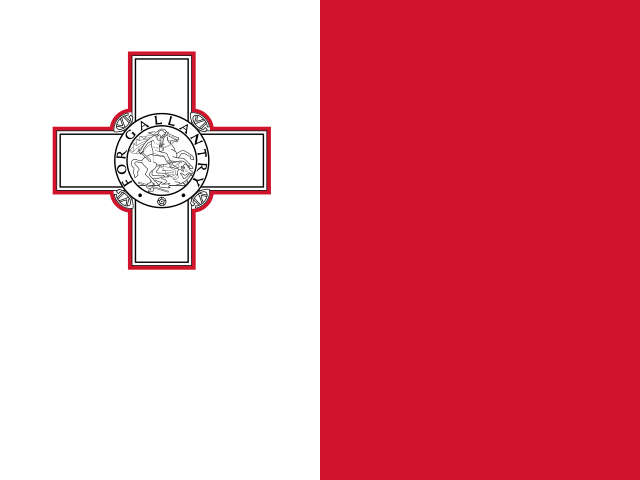 Practical essentials for Malta
Euro (EUR) — Malta joined the eurozone on 1 January 2008
Maltese and English are both official, so a visitor can get by entirely in English.
Type G, 230V 50Hz
Buses reach almost everywhere on Malta and Gozo; free travel applies only to residents, so visitors buy a €25 seven-day Explore card or pay per ride with a Tallinja card.
About 10% is usual in restaurants when no service charge has been added — check the bill first, as many places include one.
Tap water is safe to drink and meets EU standards, though it tastes strongly of chlorine and minerals because it is largely desalinated.
Left-hand side, one of only four countries in Europe to drive on the left; EU and EEA licences are valid as they are and most other visitors should carry an International Driving Permit.
112
Country-level guidance, checked against official sources. Currency, fares and entry rules change — confirm anything time-critical before you travel.


 Greece

 Croatia
 Montenegro


