
BeijingTravel Guide
China's imperial capital — the Forbidden City, the Temple of Heaven and the Great Wall rippling across the mountains to the north.
Is Beijing right for you?
Autumn
Around 32°C by day in July, 3°C in January — recorded at the local weather station.
It depends where you stand. There is a cheap version and an expensive one — the guides below say which is which.
We publish a multi-day route for this one.
Autumn
Average daily highs, recorded at Beijing (Haidian District, 46 m), 1991-2020 normals.
Where this comes from
China Meteorological Administration (English Wikipedia, 'Beijing') — Article carries six boxes (Haidian, Chaoyang, Miyun, Pinggu, Capital Airport, plus a recent-year table). Used the Haidian District station, the standard Beijing normals.
Mixed
Typical cost profile for visitors
Nothing else we cover is within a comfortable hop — this one is a trip of its own.
Finding Beijing
Reading Beijing

Beijing Off-Season: Its Secret Best Months
Empty palace courtyards, frost on golden roofs and the Great Wall without the queues — the case for Beijing in the months the crowds ignore.

Beijing, Ranked: The Experiences That Define China's Capital
The Great Wall snaking over autumn mountains, the vermilion vastness of the Forbidden City, duck carved tableside — Beijing's essential experiences, in order.

Five Days in Beijing: Start on the Axis, End on the Wall
The old city is a single straight line of a little under eight kilometres, and reading it south to north before you step off it is what turns five days in Beijing into a route instead of a scramble.

Beijing by Season: An Honest Guide to Choosing When to Go
Autumn is glorious, spring is short, summer is a crowded steam bath and winter is secretly wonderful. A frank season-by-season guide to timing a Beijing trip well.

The Markets of Beijing: What to Eat, and When to Show Up
Beijing's street food lives by the clock — jianbing at dawn, skewers after dark, candied hawthorn in winter. A dish-led guide to eating the capital's markets and hutongs well.
Beijing, framed


What we'd do in Beijing
See and do
- The Wall without the crowds
Winter is the connoisseur's season at the Great Wall.
Read: Beijing Off-Season: Its Secret Best Months - The Great Wall at Mutianyu
Nothing prepares you for seeing the Wall crest ridge after ridge to the horizon.
Read: Beijing, Ranked: The Experiences That Define China's Capital - The honest verdict
If you can choose freely, go in late September or late October.
Read: Beijing by Season: An Honest Guide to Choosing When to Go - The fringe months nobody books
Late November catches the last of autumn's clarity after the leaf-peeping crowds leave.
Read: Beijing Off-Season: Its Secret Best Months - The Forbidden City
The Ming and Qing emperors' palace is the largest ancient palace complex in the world — courtyard after courtyard of golden roofs and marble terraces leading to the Hall of Supreme Harmony.
Read: Beijing, Ranked: The Experiences That Define China's Capital
Eat and drink
- Jianbing
The crepe-like jianbing — egg, scallions, chili paste and a shatteringly crisp cracker folded inside — is Beijing's beloved breakfast, made on street-corner griddles across the city.
Read: The Markets of Beijing: What to Eat, and When to Show Up - Baozi and youtiao
Steamer towers of filled buns and vats of soy milk with fried dough sticks mark every neighbourhood's morning.
Read: The Markets of Beijing: What to Eat, and When to Show Up - And the duck
Peking duck is a restaurant ritual rather than market food, but no eating guide to Beijing can omit it: lacquered skin carved tableside, wrapped in pancakes with scallion and sweet bean sauce.
Read: The Markets of Beijing: What to Eat, and When to Show Up
Practical essentials for China
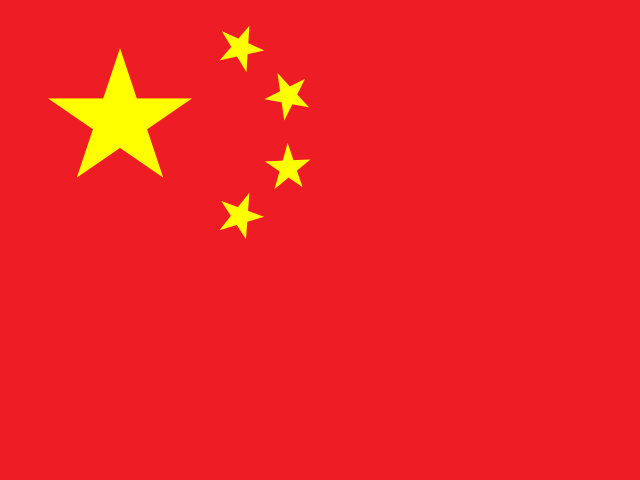 Practical essentials for China
Renminbi, or yuan (CNY); Hong Kong uses the Hong Kong dollar (HKD) and Macau the Macanese pataca (MOP)
Standard Mandarin is the national language; Cantonese dominates in Hong Kong and Macau, where English and Portuguese respectively are also official, and English is limited on the mainland outside hotels.
Type A/I, 220V 50Hz on the mainland; Type G in Hong Kong and Macau
Metros cover every large city and most visitors pay with a transit QR code in Alipay or WeChat Pay linked to a foreign card, though Shanghai and Beijing now also accept a tapped foreign contactless card, and Hong Kong runs on the Octopus card.
Tipping is not traditionally practised on the mainland and can cause confusion; Hong Kong and Macau restaurants usually add a 10% service charge instead.
Tap water is not drinkable anywhere in mainland China, including the major cities; bottled water is sold everywhere.
Right-hand side on the mainland but left in Hong Kong and Macau; an International Driving Permit has no legal standing in China, so visitors who want to drive must obtain a temporary Chinese provisional permit.
110 police, 120 ambulance, 119 fire; 999 in Hong Kong and Macau
Country-level guidance, checked against official sources. Currency, fares and entry rules change — confirm anything time-critical before you travel.


 South Korea


 Japan
Japan

 Taiwan

